
Roar – Sensed
- Date
- 1 January 2025
- Place
- Mar del Plata, Argentina
Identity, sound and coexistence between species
Presentation
Rugido – sentido (“Roar – Sensed”) is an art-science project researching imaginary forms of communication inspired by the sounds of South American sea lions (Otaria flavescens). It is a participatory audiovisual piece, but also a study of how we recognize particular sounds and search for identity through them. It is, additionally, an invitation to devise new strategies for a more sensitive relationship between human communities and the sea lion colonies of Mar del Plata.
Let’s roar, let’s listen, let’s feel
Our aim is to approach sea lions carefully, getting closer to their communicative and expressive strategies, and to the ways they produce and hear sound. But we’re also after a deeper contact, one that reaches back to the origins of our capacity to think: 1.9 million years ago, when the hominids we once were had to put themselves in another animal’s place — empathy is that old — in order to “feel as it feels” and thereby anticipate its movements.
Putting oneself in another presence’s place has effects on one’s own body. Louis Liebenberg described the physical sensations that Bushman hunters had to stay attentive to while tracking a kudu: comparing one’s own state to that of the pursued animal — proof of how central empathy is to a successful hunt, and therefore of its adaptive value in terms of natural selection.
Back to the sea lions: imitating them, and from that process, learning — promoting sonic speculation and unexplored ways of listening. Of the females, and their pups, in particular: a mother’s roars — vocalizations — are so specific to each individual that they’re known as acoustic signatures.
Acoustic vocalizations (or the sound of the females)
Our interest in sea lions was consolidated with the project Los otros lobos (“The Other Wolves,” 2022), which reflected on this animal’s place in the culture and identity of Mar del Plata. On that occasion we presented a sound installation built from recordings of the sounds produced by sea lion mothers and pups at the breeding colony on Isla de Lobos (off Punta del Este), Uruguay. Those sounds — the vocalizations — are essential to the species’ reproduction and survival; the uniqueness of the mother-pup signal is known as an acoustic signature.
Dr. Micaela Trimble, a biologist, notes that otariids tend to gather in large colonies during breeding season, and that the frequent separations between mothers and pups require a well-developed individual-recognition system for them to reunite. Studies show that acoustic signals are essential to this mother-pup recognition, and that their degree of specificity varies with colony density.
Method
We gave a group of people a list of nine examples of female vocalizations, and a second list of nine examples of pup vocalizations. Each person listened to every example and chose to imitate one case from each list — one adult female vocalization and one pup vocalization — forming their hypothetical mother-pup pair. We recorded (image and sound) each person reproducing both vocalizations, keeping their selection secret until the project’s final stage.
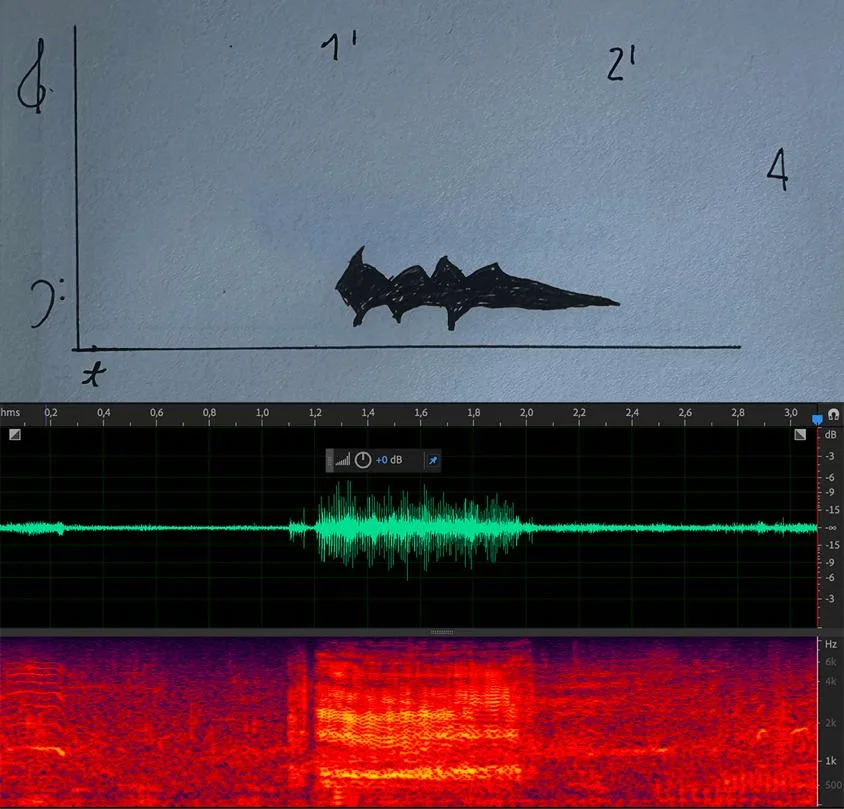
The audio is accompanied by a spectrogram and a graphic (symbolic) score to aid memorization and selection of each vocalization, and to draw attention toward the musical dimension too: these vocalizations can be considered an articulate, expressive, and notatable sound material.
Recognition (results)
The final stage consisted of sharing the recordings among participants:
- Recognizing one’s own vocal timbre.
- Recognizing one’s own selected vocalization as reproduced by others.
- Detecting the timbre and mother-pup pairs among other participants’ selections.
- Distinguishing as many vocalizations as possible.
- Confirming all the pairs and who produced each vocalization.
- Comparing the spectrograms of the roars produced by participants.
It’s on this last point that we think the project connects with new research crossing acoustics, philosophy, sociology and sound art.
Materials
- Mothers’ vocalizations — audio
- Mothers’ vocalizations — scores
- Pups’ vocalizations — audio
- Pups’ vocalizations — scores
Credits
- Project: Martín Virgili
- Executive production: Candela Chirino
- Camera: Maximiliano Tazza
- Sound: Guido Bressan
- Voiceover: Gastón Mazières
- Biology specialists: Dr. Gisela Giardino, Dr. Sofía Copello
Roarers: Paula Elgarrista, Gisela Giardino, Juan Pablo Se Copon, Carolina D’Alessandro, Lucila Dovao Medin, Sofía Copello, María Alejandra Estifique, Francisco Ramallo, Candela Chirino, Guido Bressan, Matías Tazza, Francisco Bezich, Leila Ale Wagner, Agustina Suero, Pablo Engel, Inés Drangosch, Manuela Sánchez, Paola Carobino, Florencia Campoamor.
Bibliography
- Morizot, Baptiste (2020). Tras el rastro animal. Buenos Aires: Isla desierta.
- Liebenberg, L. (2006). “Persistence Hunting by Modern Hunter‐Gatherers”. Current Anthropology, 47(6), 1017–1026.
- Trimble, M., Charrier, I. (2011). “Individuality in South American sea lion (Otaria flavescens) mother–pup vocalizations”. Mammalian Biology.
- Virgili, Martín (2022). “De lobos, lobas, identidades y contradicciones”. Mar del Plata: Universidad Tecnológica Nacional. Read online