
The Other Wolves
- Date
- 5 October 2022
- Place
- Museo MAR, Mar del Plata, Argentina
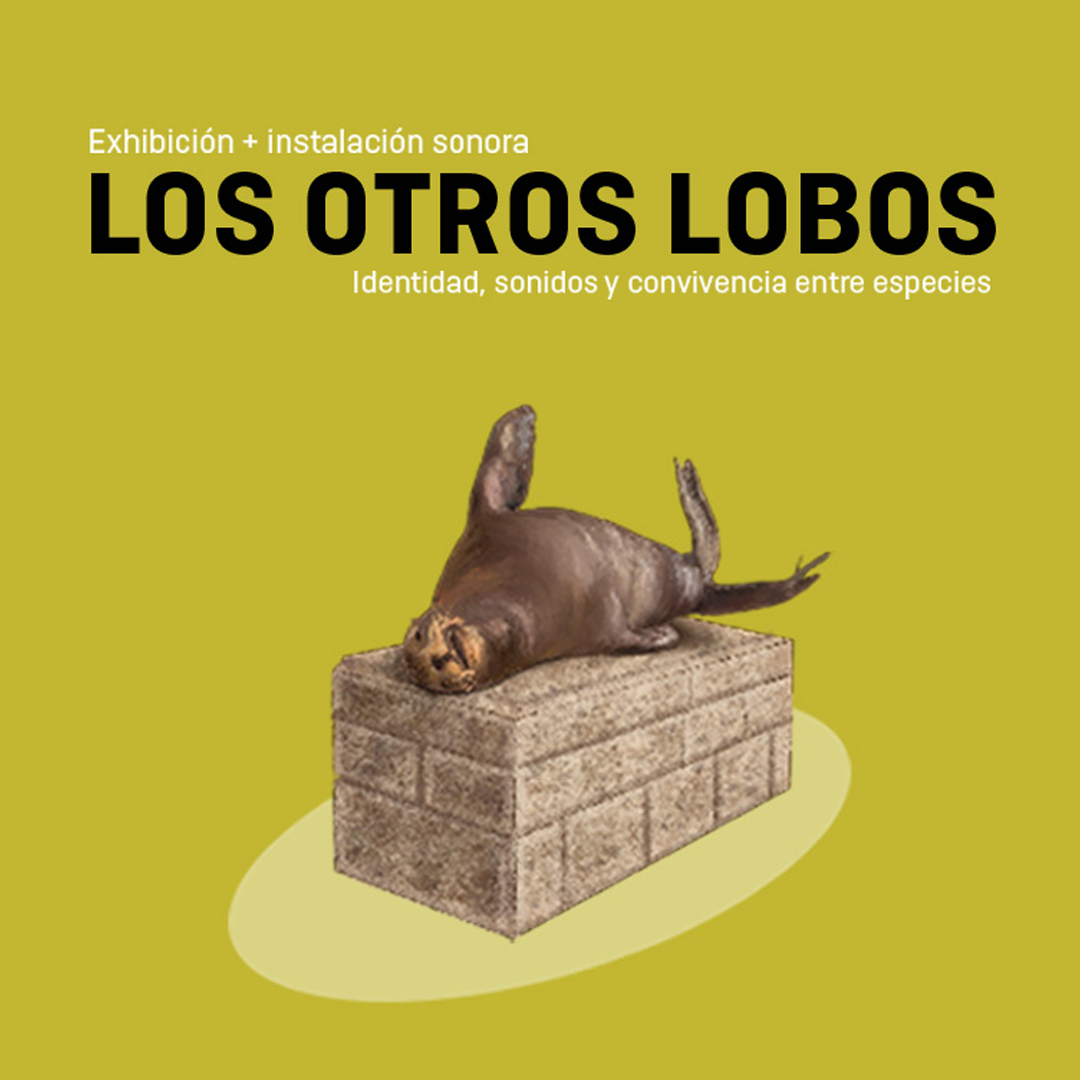
Identity, sound and coexistence between species
Of wolves, she-wolves, identities and contradictions
Los otros lobos (“The Other Wolves”) is an interdisciplinary project reflecting on the figure of the South American sea lion (Otaria flavescens) in the culture and identity of Mar del Plata. Its surprising sonic and social faculties, as well as its territorial practices, inspire us to imagine new alternatives for rethinking the uses of sound, space, and interspecies relations between the community and these remarkable animals.
Because of a strong local iconography, the city’s identity is visually shaped by the sea lion symbol embodied in the famous sculpture “Monumento al Lobo Marino” (1940), attributed to Argentine artist José Fioravanti. As with the port’s traditional yellow boats — identity symbols on the verge of extinction — sea lions as real animals are unknown, displaced and inconvenient beings. The friction between the sea lion of stone and the sea lion that lives and breathes is central to this research, which we believe can help us detect a logic of worship/contempt characteristic of local culture.
The exhibition engages with that monumental context — a model specimen, healthy, dominant-featured, posed with power and grandeur — which masks the age and physical diversity of the species. The Other Wolves seeks to unframe that symbol, bringing us closer to the real animal and its fascinating evolutionary qualities.
The project is completed with a sound installation built from the vocalizations of females at the breeding colony on Isla de Lobos (off Punta del Este), Uruguay, known as acoustic signatures.
The displaced
Sea lions lived here before we did. Before it was Mar del Plata, this was Lobería Grande, a territory inhabited by a large breeding colony of the species. From the earliest human settlements onward, a not-always-friendly coexistence between the two species began to be improvised: in 1895, a bathers’ guide promoted the area by promising that “here you’ll find splendid entertainment, and can even have a good time hunting sea lions” (Rodriguez, 1998). The sea lion left the city and turned into a stone monument, replicated on souvenirs, alfajor wrappers, t-shirts and every kind of object.
Symbols shape perceptions. The animalization of behaviors drives us to build typologies among individuals and weaves a particular value system into society. But communities and animals are more complex. Much of what contemporary societies face today has to do with building new practices of coexistence between humans and animals. Baptiste Morizot calls this particular symbiosis ecological intelligence:
“It’s an ecological intelligence we seem to have forgotten somewhere along the way, from the moment we began to think of the giving environment as Nature, then nature as mere matter, and shut ourselves behind our human doors, losing contact with the great vital politics of the animal and plant community.” (Morizot, 2020)
That’s why we want to show the other wolves — the real animal: a dynamic sea lion that eludes the connotations of “supremacy,” “strength” and “virility” poured into the social imaginary through the symbol-wolf.
The exhibition
We exhibit twelve 1.4 × 1.4 m illustrations, reworked with graphic design, presenting the sea lions of Mar del Plata under an iconography that emphatically departs from the exemplary, symbolic wolf of the 1940 sculpture. A repertoire of diverse sea lions — resting, pups, injured in fights, in fishing season — is shown using the same visual rhetoric normally reserved for the stone wolf, each accompanied by a short caption noting a particular trait of the species.
The exhibition is completed with a sound installation built from processed recordings and field takes of the females’ vocalizations, the acoustic signatures. Reproducing those sounds is a way of making present the other end of the species, which for reasons of population distribution doesn’t live in Mar del Plata.
Acoustic signatures
We use this term for an extremely characteristic sound that a female sea lion teaches her pup from its earliest days of life, which lets the pup identify her. Although to the human ear these sounds are indistinguishable, pups learn to tell them apart with extremely high precision — a sonic bond fundamental to the species’ development.
Bibliography and related information
- Morizot, Baptiste (2020). Tras el rastro animal. Buenos Aires: Isla desierta.
- Rodriguez, D., & Bastida, R. (1998). “Four hundred years in the history of pinniped colonies around Mar del Plata, Argentina”. Aquatic Conservation: Marine and Freshwater Ecosystems, 8(6), 721-735.
- Trimble, M., Charrier, I. (2011). “Individuality in South American sea lion (Otaria flavescens) mother–pup vocalizations”.
- La travesía de los lobos marinos (blog)
- Perro mío! (fiction documentary)
- Fluctuat Nec Mergitur — documentary on the construction of the port of Mar del Plata
Credits
- Project: Martín Virgili
- From the biological sciences: Gisela Giordano, Sofía Copello, Marcelo Lucero
- Visual artists: Jorge Ihlenfeld, Pablo Engel, Carolina Nervegna, Marco Pavka, Manuel Ullúa, Agustín Alix
- Web design: UTN Mar del Plata
- Graphic design: Mariano Losi
- Logistics and creative direction: Candela Chirino
- Sound editing: Martín Virgili
- Piano recordings: Mariano Losi
- Field recordings (females and pups): Micaela Trimble
- Production: Centro de Arte y Ciencia (CEAC) – UTN Mar del Plata, October 5–10, 2022
UTN Mar del Plata Regional Faculty. Dean: Fernando Scholtus. Vice Dean: Lucas Lani.