
Maps for Listening
- Date
- 1 March 2021
- Place
- La Perla neighborhood, Mar del Plata, Argentina
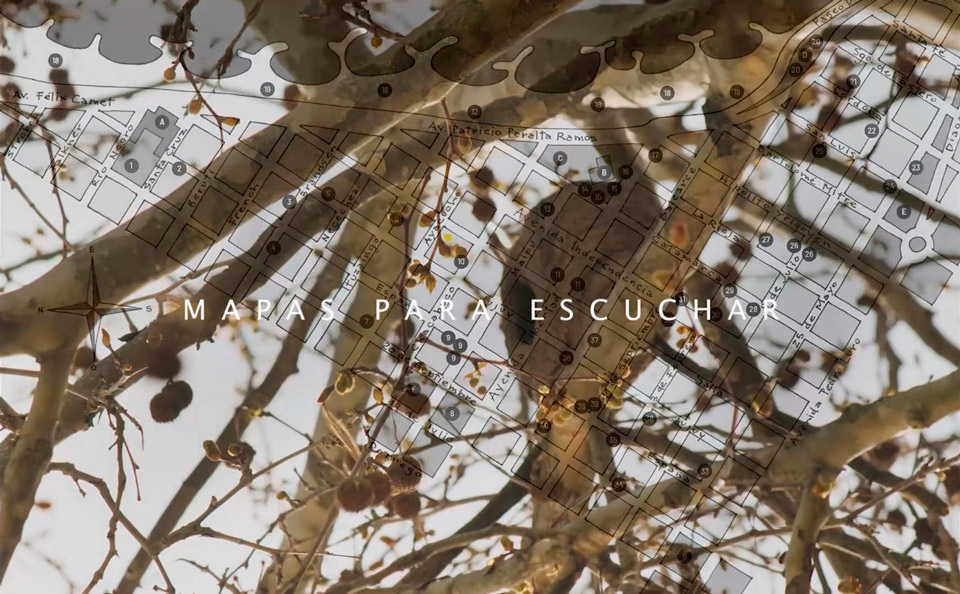
Mapas para escuchar (“Maps for Listening”) is an urban-intervention project in the La Perla neighborhood of Mar del Plata that, taking birdsong as its starting point, tries to reveal the relationships built between sound and place, and how listening appeals to our memory and our sense of belonging.
The etymology of the German word for “to belong” is connected to the word “to listen”: gehören translates as “to belong,” while the root of the word hören means “to listen.” In his book Acoustic Communication, Barry Truax describes the concept of acoustic community, in which sound acts positively, creating a unifying relationship with the environment.
The project’s goal was to create a map of sound coordinates by identifying, recording and mapping the “sound points” — trees and urban structures — where birdsong concentrates. These points begin to activate toward the end of winter with the first trills, reaching full sonic bloom during spring and continuing through summer.
The large, fold-out map — like a typical tourist map — also serves as a guide to the bird species living in the neighborhood and the trees that shelter them, and is distributed freely among residents and visitors. The sound points are marked in urban space with the inscription “listen, the birds sing here.” The sound recordings are available online as a sonic-heritage archive.
40% of the more than 11,000 bird species on the planet are in population decline, and one in eight is under threat, according to a 2018 BirdLife International report — the main cause being the ongoing destruction of their habitats.
In his essay Five Practices for Listening to the Language of Birds, biologist David G. Haskell recounts how birds’ voices produce a new dimension of sensory experience. Birdsong reveals the passing of the seasons and the different hours of the day, and its texture shapes the neighborhood’s soundscape.
In the late 1960s, a group of researchers under the name World Soundscape Project — founded at Simon Fraser University in Vancouver by Murray Schafer and Barry Truax — proposed “to document and archive soundscapes, describe and analyze them, and promote increased public awareness through listening and critical thought.” Unlike the sound-map projects that exist online today, Mapas para escuchar tries to intervene directly in a specific territory, marking its sound points and offering its inhabitants a map to walk, explore and discover — creating new sensory and affective relationships with the place.
The sound recordings are published as a sonic-heritage archive on Bandcamp.
Project video on Vimeo.