
Listening: A Material History of Western Sound Perception
- Date
- 12 May 2015
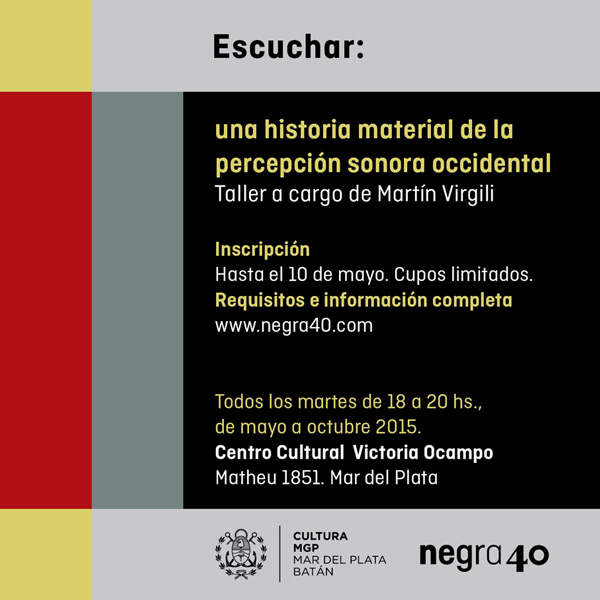
Centro Cultural Victoria Ocampo and Negra40 Present
Listening: a material history of Western sound perception Martín Virgili
Download the full program as a PDF: https://www.negra40.com/n40/wp-content/uploads/2020/11/TallerEscucha2015_InfoCompleta.pdf
Registration and requirements
The workshop offers 20 scholarships/places, including all bibliographic materials and sound recordings. Applicants must send a statement of intent summarizing their reasons for wanting to take part in the workshop.
In the body of the message, please include: first and last name, date of birth, occupation, and landline and mobile phone numbers.
Message subject line: becas escuchar 2015 + full name
Deadline to send the message and details: Sunday, May 10, 2015
Schedule
Workshop day and time: every Tuesday, 6:00 to 8:00 pm, from May to October 2015.
First session and introduction: Tuesday, May 12, 2015, 6:00 pm.
Location: Microcine, Centro Cultural Victoria Ocampo, Matheu 1851, Mar del Plata.
Martín Virgili (1976)
Holds a degree in Arts, music track (UBA). Composer, guitarist, teacher, and arts researcher. He studied composition with Ricardo Capellano and Gabriel Valverde, and musical aesthetics with Margarita Fernández. He has received grants from the Université de Paris 1 (Panthéon-Sorbonne), the University of Helsinki, the Fondo Nacional de las Artes, the Fundación Telefónica de Argentina, and the Centro Cultural España in Buenos Aires. His works have been presented in Argentina, Chile, Finland, Colombia, Venezuela, Canada, Mexico, Switzerland, and the United States, and premiered by renowned ensembles and soloists. He has taught courses and seminars at Duke University (North Carolina, USA); at the Universidad Javeriana, the Universidad CORPAS, and the Academia Superior de Artes in Bogotá, Colombia; at ESMUC (Escola Superior de Música de Catalunya) in Barcelona, Spain; at the CNA (Centro Nacional de las Artes) in Mexico City; and at CMMAS (Centro Mexicano para la Música y las Artes Sonoras) in Morelia, Michoacán. In Argentina, he served as a director and instructor at CEAMC (Centro de Estudios Avanzados en Música Contemporánea) and taught courses and seminars at the Universidad Tecnológica Nacional and the Universidad Nacional de Luján. He has collaborated with artists including Jacques Demierre (Switzerland); Vincent Barras (Switzerland); Margarita Fernández; Llorenç Barber (Spain); Guillermo Bocanegra (Colombia); Daniel Áñez (Colombia); Rodolfo Acosta (Colombia); Simon Steen-Andersen (Denmark); Ana María Romano (Colombia); Luca Belcastro (Italy); Elsa Justel; Pablo Jivotovschii; Mariano Malamud; Mariano Losi; Inés Sabatini; Guillermo Lema; among others. He directed the films “Desde las montañas” (2009, 52’) and “Fluctuat Nec Mergitur” (2014), and has authored various publications on musicology and musical aesthetics. He currently forms, with Pamela Guruciaga, the duo Orange Music, performing pieces from the musical, theatrical, and music-theater repertoire. He is a member of the Club del Dibujo (Mar del Plata chapter) and directs the Orquesta Inestable del Club del Dibujo. He is a member of the Ensamble Orquesta Negra together with guitarist Guillermo Bocanegra and playwright Gastón Maziéres. He is a founding partner, together with designer Jorge L. Ihlenfeld, of the negra40.com project.
“For twenty-five centuries Western knowledge has tried to see the world. It has still not understood that the world is not something one looks at, but something one hears. It is not something one reads, but something one listens to.”
Jacques Attali
Listening: a material history of Western sound perception.
Summary
To propose a history of listening is to attempt a history of relation. Listening, beyond aesthetics and acoustics, is an exercise in (re)knowing the world and the other. Surrounded by matter in motion, every thing has a note, a vibration that identifies and distinguishes it. The mesh that makes up physical existence is nothing but the sum of all those partial notes gathered into one vast, inscrutable sonic whole. Whoever listens, sees the world: sound registers its material and symbolic trace. Under these terms, this workshop will trace an aesthetic and social history of the sonic trajectory of the West, establishing, alongside it, a musical history of listening as appropriate.
Those of us who hear cannot help but listen. Wherever we go, a sonic frieze accompanies our actions and our intentions. Hearing is the first sense that connects us to the world, many months before all the others. Our ear, in turn, vividly describes for us the texture of things invisible and distant, and warns us of lurking dangers. Its hand touches what hides behind walls and behind the night. A lie can escape almost everything except the attentive perception of one who knows how to read the timbre of a cracking voice. Fear and understanding travel through the air: an unusual sound can keep us up all night. A sincere word can change our life.
In the same way, sounds establish the web that relates the subject to the socius, shaping a collective sonic network without which life would not be possible. The noises of labor, of agreements, of conspiracies. Wherever a social form exists, there is sound. Silence, for that very reason, marks the alliance between solitude and muteness: “Among birds, the vulture is the only one that sacrificed the flock for solitude, and song for elevation” (Quignard, 1998). Societies thus take part in an uninterrupted, atavistic sonic design, and the manner and determinations of those sounds trace the subtle outline of their politics, economies, mentalities, and aesthetics.
Following Attali, we can see that Listening may be thought through three sonic instances: (a) music used in rituals to make people forget generalized violence; (b) the use of music to instill belief in the harmony of the world, in order and in economic exchange; and finally (c) music that serves to silence, through the incessant reproduction of deafening sounds that drown out the remaining noises made by human beings. Against any of these forms of power, listening marks its own limit and its antidote. Whoever listens goes out, walks, moves.
Musical sources
- ACOSTA, Rodolfo (1997). Una guitarra naranja.
- AHARONIÁN, Coriún (2000). Llueve sobre el Río de La Plata.
- BACH, J. S. (1749). El arte de la fuga.
- BACH, J. S. (1749). Variaciones Golberg.
- BEETHOVEN, L. W. (1823) 9na. Sinfonía. Op. 125.
- BINGEN VON, Hildegard (1175). Symphonia aemonie celestium revelatium.
- CARDEW, CORNELIUS (1963–1967) Treatise.
- CAGE, J. (1938-51) Sonatas e interludios para piano preparado.
- CAGE, J. (1952) Water music.
- DES PREZ, Josquin (1511). Tu solus qui facis mirabilias.
- DUCHAMP, Marcel (1913). Erratum Musical.
- FEDLMAN, M. (1952). Pieza para piano 1952.
- FEDLMAN, M. (1971). Rothko Chapel.
- KAGEL, Mauricio (1996). Eine Brisse.
- KOELLREUTTER, Hans Joachim (1989). Wu li.
- LACHENMANN, Helmut (1966). Trío fluido.
- LACHENMANN, Helmut (1969). Güero.
- LUCIER, Alvin (1969). I am sitting in a room.
- MACHAUT, Guillaume (ca. 1365). Misa de Notre Dame.
- MONTEVERDI, Claudio (1612). Orfeo y Euridicce.
- MOZART, W. (1787). Don Giovanni.
- NONO, Luigi (1992). La lontananza nostalgica utopica futura.
- PARASKEVAÍDIS, Graciela (1992). El nervio de arnold.
- PERI, Jacopo (1600). Euridicce.
- PEROTIN (ca. 1198). Organuum.
- PINZON, Jesús (2005). Visiones.
- ROMANO, Ana María (2003). Sin coincidencias III.
- SATIE, Erik (1893). Vejaciones.
- SCHUMANN, R. (1830). Op. 12. In der Nacht
- SCHÖNBERG, A. (1912). Pierrot Lunaire. Nacht.
- SCHUBERT, Franz (1828). Sonata en La mayor. D. 959.
- SIGAL, R. (2010). Sinapsis.
- WAGNER, Richard (1853). El Oro del Rin. Preludio.
- WAGNER, Richard (1857-59). Tristán e Isolda. Preludio.
- WEBERN, Anton (1911–1913). Bagatelas Op.9.
- XENAKIS, Iannis (1953-54). Metástasis.
Bibliographic sources
- ADORNO, Theodor W (1966). Filosofía de la nueva música. Buenos Aires: Sur. ___ (1970). Reacción y progreso. Barcelona: Tusquets. ___ (1983). Teoría estética. Madrid – Buenos Aires: Hispamérica.
- ARIZA, Javier (2008). Las imágenes del sonido. Cuenca: Ediciones de la Universidad de Castilla-La Mancha.
- ATTALI, Jacques (1995). Ruidos. Madrid: Siglo XXI.
- AZCUY, Eduardo A. (2014). El ocultismo y la creación poética. Buenos Aires: Editorial Biblios.
- BARBER, Llorenç (1985). John Cage. Madrid: Círculo de Bellas Artes.
- BLACKING, John (2006). ¿Hay música en el hombre? Madrid: Alianza Editorial.
- BOULEZ, Pierre (2009). Pensar la música hoy. Murcia: Edición Cajamurcia.
- CAGE, John (2007). Silencio. Madrid: Árdora Ediciones. ____ (2007). Escritos al oído. Murcia: Fundación Cajamurcia.
- CIRLOT, Victoria (1997). Vida y visiones de Hildegard von Bingen. Madrid: Siruela.
- CHESTERTON, Gilbert K. (1988). El hombre que fue jueves. Madrid: Losada.
- DAHLHAUS, Carl (2014). La música del siglo XIX. Madrid: Akal.
- DAHLHAUS, Carl and EGGEBRECHT, Hans H. (2012). ¿Qué es la música? Barcelona: Acantilado.
- DELEUZE, Gilles (1978). Conferencia sobre el mundo musical. In “Deleuze Conferences.” Webdeleuze.com
- DERRIDA, Jacques (1995). Dar (el) tiempo. I. La falsa moneda. Barcelona: Paidós.
- FOUCAULT, Michael (2002). La hermenéutica del sujeto. Mexico City: Fondo de Cultura Económica.
- GÁMEZ, Luis (2012). El arte del ruido. Barcelona: Ediciones Alpha Decay.
- GOULD, Glenn (1984). Escritos críticos. Madrid: Ediciones Turner.
- HOBSBAWN, E. J. (1977) La era del capitalismo I. Madrid: Ediciones Labor.
- HUGHES, Ted (2013). El pensamiento zorro. Buenos Aires: LIMACHES250.
- JANKÉLÉVITCH, Vladimir (2005). La música y lo inefable. Alpha Decay: Barcelona.
- KAGEL, Mauricio (2011). Palimpsestos. Buenos Aires: Caja Negra.
- KAPROW, Allan (2013). Ensayo sin título y otros Happenings. Mexico City: Ediciones Tumbona.
- LE BRETON, David (2006). El silencio. Aproximaciones. Madrid: Sequitur.
- LEMA, Guillermo and VALVERDE, Gabriel (2006). La música utópica. Buenos Aires: Vian Ediciones.
- LICHT, Alan (2007). Sound Art. Beyond Music, Between Categories. New York: Rizzoli.
- MANN, Thomas (1998). Doktor Faustus. Barcelona: Edhasa.
- MARCUS AURELIUS (2008). Meditaciones. Buenos Aires: Del Nuevo Extremo.
- McLUHAN, Marshall (2004). Visual and Acoustic Space. In “Culture: Readings in Modern Music.” New York-London: Continuum Press.
- MONJEAU, Federico (2004). La invención musical. Ideas de historia, forma y representación. Buenos Aires: Paidós.
- NYMAN, Michael (2006). La música experimental. De John Cage en adelante. Barcelona: Documenta Universitaria.
- PROUST, Marcel (1999). En busca del tiempo perdido. 1. Por el camino de Swann. Madrid: Alianza Editorial. ____ (1998). En busca del tiempo perdido. 2. A la sombra de las muchachas en flor. Madrid: Alianza Editorial. ____ (1998). En busca del tiempo perdido. 3. El mundo de Guermantes. Madrid: Alianza Editorial.
- QUIGNARD, Pascal (1998). El odio a la música. Santiago, Chile: Andrés Bello.
- QUIROGA, Horacio (1963). El salvaje. Buenos Aires: Losada.
- RAMIREZ, Juan A. (1993). Duchamp. El amor y la muerte, incluso. Madrid: Ediciones Siruela.
- RETALLACK, Joan (2011). John Cage. Visual art. John Cage en conversación con Joan Retallack. Santiago, Chile: Ediciones Metales Pesados.
- RUSSOLO, Luigi (1913). Manifiesto.
- SCHAEFFER, Pierre (2008). Tratado de los objetos musicales. Madrid: Alianza Editorial.
- SCHAFER, Murray (2013). El paisaje sonoro y la afinación del mundo. Barcelona: Intermedio.
- VIGO, Edgardo A. (1960–1969). Diagonal 0. La Plata: Diagonal 0.
- VIRGILI, Martín (2013). Un oyente experimental. In “La Capital.” Mar del Plata: Ediciones Capital.
- VIRILIO, Paul (2001). El procedimiento Silencio. Buenos Aires: Paidós.
- VOEGELIN, Salomé (2010). Listening to Noise and Silence. Toward a Philosophy of Sound Art. New York: Continuum Press.
- WEBERN, William (2008). La gran transformación en el gusto musical. La programación de conciertos de Hyden a Brahms. Buenos Aires: Fondo de Cultura Económica.
- WOOLF, Virginia (1999). Orlando. Barcelona: Sudamericana.