
Elsa Justel – The Sensory Illusion
- Date
- 1 June 2013
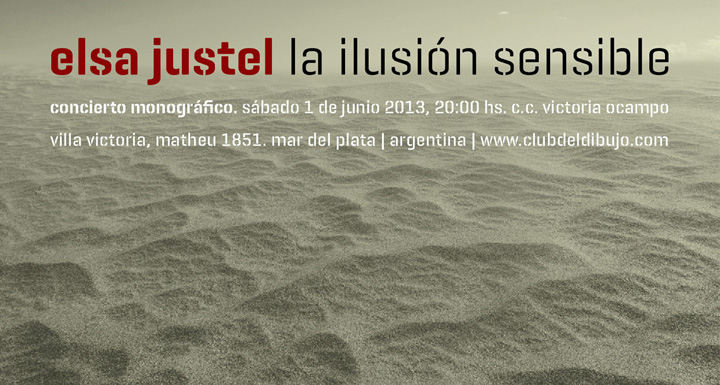
Club del Dibujo presents
Elsa Justel The Sensory Illusion
Solo concert. Saturday, June 1, 2013, 8:00 pm
Centro Cultural Victoria Ocampo Villa Victoria, Matheu 1851 Mar del Plata, Argentina
Program
1. Mâts (1999) (acousmatic)
Commissioned by the French State and the GRM Dedicated to Juan
Like the pulleys of masts swayed by the wind, the rigging of an imaginary ballet lets its limbs vibrate in a frenzied dance. The voice of the erkencho grew hoarse and raw. It is no longer its throat that sings, nor its guts that shudder: it is its bone that screams.
Submerged in the liquid world of the rainstick, the horn emerges again and again, dancing and mocking, letting out an acid song that will never end.
Text by Elsa Justel. The piece was created from the sounds of primitive instruments from various cultures, among them: erkencho, rainstick, small Chinese drum, bamboo, etc. Premiered at the Salle Olivier Messiaen, Paris.
2. The Sensory Illusion (1995) (video music)
Made possible by a grant from the Institut de l’Audiovisuel of the Universitat Pompeu Fabra in Barcelona, the piece is based on research into perceptual illusions. The project seeks to draw parallels between certain visual and auditory perceptual effects and specific parameters of image and sound.
Photographs of objects made of different materials, and recorded sounds of those same materials, were used in its making, so as to also establish perceptual associations.
Premiered at the ENSEMS Festival, Valencia, Spain.
3. Bastet (2004) (acousmatic)
Produced at the EMS studios in Stockholm (Sweden) Ton Bruynel Prize (Netherlands)
Bastet, that mischievous cat goddess, has slipped inside the piano. Confused by the otherworldly appearance of her surroundings, she tries to find her way out by scratching at the strings.
Text by Elsa Justel. The sounds used come from piano strings, guitar strings, and a snare drum, played in unconventional ways. The project is based on the notions of ambiguity, instability, and chance. The character of the piece tends to exploit the spectral instability inherent to string sounds, aiming to produce nuances of character and ambiguous effects.
Premiered at the World Music Days, Amsterdam (2005).
4. Rouilles (2010/12) (video music)
Based on photographs taken in 2004, it reflects what was once a reality at the Port of Mar del Plata. For many years boats accumulated there — abandoned by their owners, they languished and slowly corroded into a mass of rust. Fortunately, that dishonorable metal graveyard is being dismantled, restoring the area’s natural balance and returning it to the function for which it was created.
Yet in the memory of those of us who lived through that era, a very particular resonance remains: the images and memories transform and become other images, reflecting the immanent beauty of materials degraded by time. Metal, wood, rust, and flaking paint resonate to give shape to a polyphony of timbres that accompanies the rhythm of those images.
Screened in the exhibition Equilibrio-Desequilibrio at the Teatro San Martín, Buenos Aires (January 2013).
5. Follaje de Silencio (“Foliage of Silence”) (1994)
For flute, oboe, and electronics. Julieta Blanco (flute) Mariano Cañón (oboe)
Commissioned by the GRM in Paris. Dedicated to my father.
Drawing a parallel between the composer and the gardener has always seemed very natural to me. Having lived in the countryside as a child, I had occasion to watch my father carefully tending the harmonious growth of his plants.
Like the “good gardener,” we composers need to experiment with and handle sounds with care, in order to reach that ideal of beauty that always seems to us elusive and ungraspable. The choice of instruments was not left to chance. Rereading Pousseur (see note), I found this phrase that still feels relevant to me today: “Whether we like it or not, the age of flutes and oboes, whose charm must be guessed at and made to be guessed, remains absorbed by that of the trumpet, the drum, and the scream.”
Premiered at the Salle Olivier Messiaen of Radio France by Vincent Touzet (flute) and Hélène Devilleneuve (oboe).
Note: Henri Pousseur, “Music, Semantics, Society,” Ed. Casterman, Brussels, 1972.
Elsa Justel
Elsa Justel. Franco-Argentine composer and video artist, born in Mar del Plata. She holds a doctorate in Aesthetics, Sciences, and Technologies of the Arts from the University of Paris-Sorbonne. Member of the Doctoral College of the University of Paris-Nord, of CICM (Center for Computing and Musical Creation), and of AFIM (French Association for Musical Computing). Her music and videos have won awards in numerous international competitions, including the International Electroacoustic Music Competition of Bourges (1989 and 2001), the Prix Ton Bruynel (Netherlands, 2005), the Phonurgia-France Culture Prize (2001), the Stipendienpreis in Darmstadt (Germany, 1990), the Prix Ars Electronica (Linz, Austria, 1992), Video Evento d’Arte (Italy, 2002), and the Tribunas de Música Contemporánea y Electroacústica in Buenos Aires, Argentina (2000, 1989, 1987).
Her musical and audiovisual production has been broadcast and screened at the most important international electronic art festivals, and released by the label Empreintes DIGITALes of Canada (electrocd.com), J&W (Canada), 00Discs (EU), Acousmatica (France), Organised Sound (UK), and La Muse en Circuit / Radio France / WDR3. She has received numerous commissions from the French State and various European studios.
Gallery Photos: Gustavo Morales