
Beuys 2021
- Date
- 16 April 2021
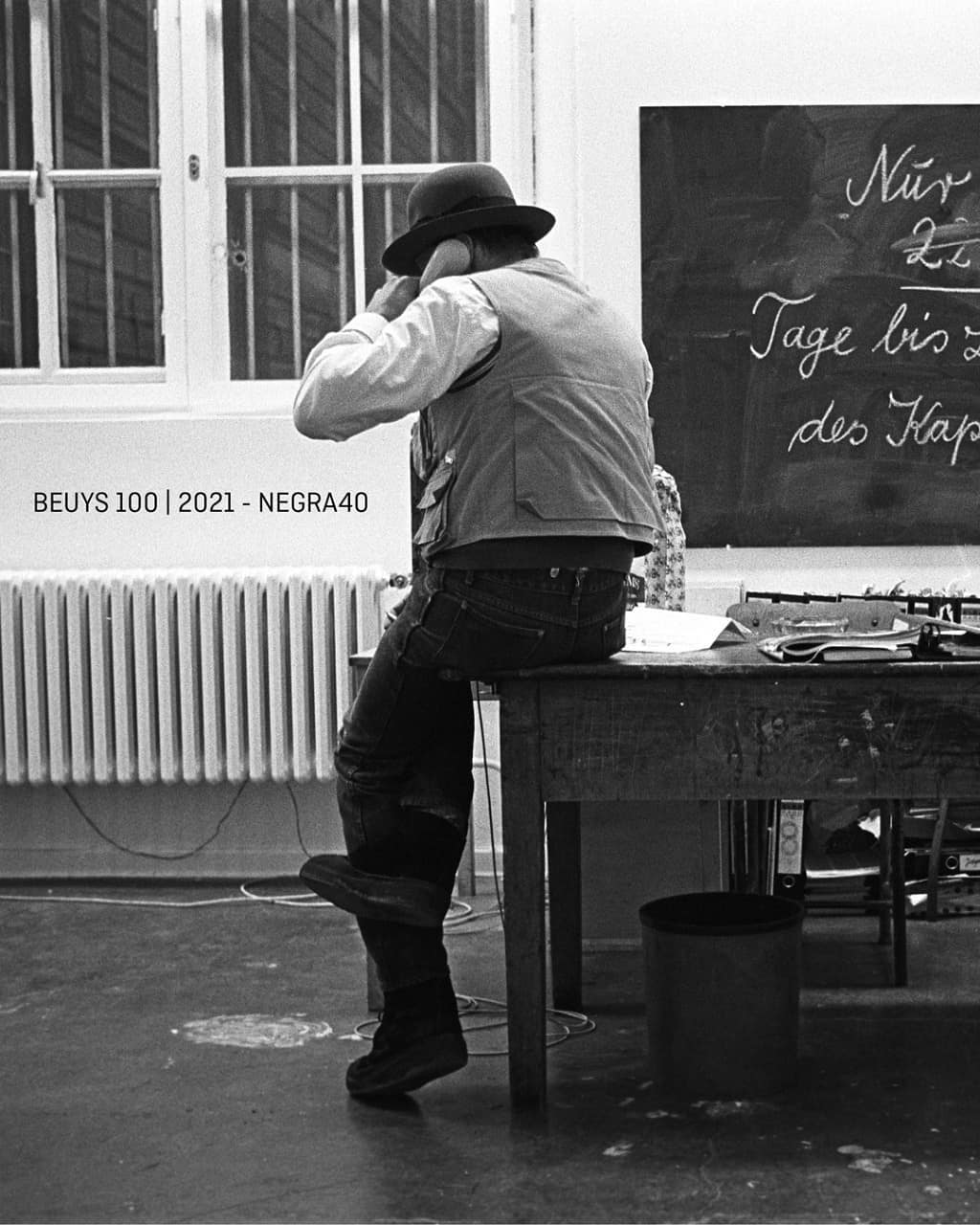
Introduction
The 21st century marks the centenary of his birth amid an unprecedented crisis of meaning for current generations, with very low levels of energy to face this reality. Yet not without a certain prophetic edge, Beuys’s eruption into this mire seems to remind us of his diagnoses and the causes of stagnation: that the pace of change remains slow in our societies, and that it has slowed further still since the screening of social relations. And that the way out remains the human being.
Tribute
Negra40 remembers Joseph Beuys with 4 days of actions on the beaches, cliffs, and forests of Mar del Plata, Argentina, from April 16 to 19, 2021.
- Day 1: Amazonian Ceremony
- Day 2: Sound Installation
- Day 2: Walks in the Forest and the Sea
- Day 3: Temazcal
- Day 4: Arbolatum, Music for a Forest
Joseph Beuys was one of the most significant artists of the 20th century, fact.
In 2016, on the occasion of the 40th anniversary of his death, we organized “Ampliación,” the first Negra40 and Club del Dibujo conference days aimed at reviving three central axes of his poetics: matter, heat, and social sculpture. The 21st century marks the centenary of his birth amid an unprecedented global crisis of meaning for current generations, with very low levels of energy to face this reality. Yet not without a certain prophetic edge, the Beuysian eruption into this mire seems to remind us of its diagnoses and the causes of stagnation: that the pace of change remains slow in our societies, and that, above all, it has slowed more and more since the screening of social relations. And that the way out remains the human being.
This state of affairs leads us directly to register the deep meaning that Beuys’s figure and work come to inscribe in this present, and we believe it is integrity. The crisis is not artistic, although we do observe a significant shortage of ideas feeding artworks and in the corporate perspectives of the institutions that regulate them. Art is not the central problem. The crisis, as Josep Maria Esquirol announced, originates in the failure to recognize the basic coordinates that bind us to the world and to others, and in the absurd efforts made to evade them. The “someone,” the “everyday,” the “close,” the “shelter,” the “softness,” the “simplicity,” the “friendship,” the “sincerity,” the “poverty,” the “community” — all have yielded to the illusory disintegration of a global village made of ghosts. Joseph Beuys’s militancy rested on presenting a unified image of art and artistic relationships within a paradigm in which art ceased to be an accessory part of the great economic and political axis, and instead presented itself as the axial center around which all other relations are reordered. That is why the crisis is one of integrity.
The artist’s centenary condenses and expands us. It draws us once more into the intimacy of personal, affective, and cosmic processes, only to later embody and share them communally. What matters today? Where should we put our energy? Where does art find a poison-free space to watch the seed grow? What institution, in the same way, will shelter us according to Pavese’s maxim: “you will be loved the day you can show your weakness without the other using it to affirm their strength”?
We see no other way out.
To remember Beuys is to remember a way of proceeding that came before him, one to which we bow and which we celebrate as a community.
Negra40