
Ac-to – Sound Poetry of Action
- Date
- 28 November 2015
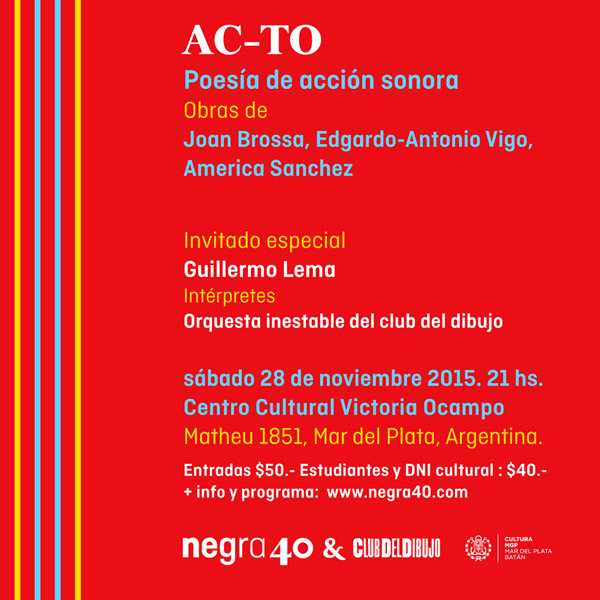
Centro Cultural Victoria Ocampo Negra40 Club del Dibujo present
Ac-to, Sound Poetry of Action
works by Joan Brossa Edgardo-Antonio Vigo América Sanchez
Special guest Guillermo Lema
Performers Pamela Guruciaga Mario Gemín Jorge Ihlenfeld Sabrina Salomón Martín Virgili
Members of the Orquesta Inestable of the Club del Dibujo
Saturday, November 28, 2015 9:00 pm.
Centro Cultural Victoria Ocampo Matheu 1851, Mar del Plata, Argentina.
Admission: $50.- Students and DNI Cultural cardholders $40.-
Program
Verso (1968 – 1979 – 1982) America Sanchez
World premiere (abridged version)
Selected poems Joan Brossa
Dècoupe (2006) Jacques Demierre / Vincent Barras Había una vez (“Once Upon a Time”) (2006) Guillermo Lema
… simultaneously with…
Incidental music (1961) George Brecht
… simultaneously with…
Lavoro (1965) Giuseppe Chiari
… simultaneously with…
Memories of you (1966) Cornelius Cardew
Teorema fundamental (“Fundamental Theorem”) (1966) from the series Poemas matemáticos (“Mathematical Poems”) Edgardo-Antonio Vigo
World premiere. Version for four performers by Martín Virgili
Sobre el suicidio (“On Suicide”) (1948) Antonin Artaud
Direction and staging by Guillermo Lema. Images: Eduardo Alvarado
Note
On Saturday, November 28, writer and performer Guillermo Lema will visit Mar del Plata with a program that lets us appreciate both facets of his art.
The concert is also a landmark in terms of its repertoire and authors. A case in point is the premiere of Verso, a composition by Argentine graphic artist and designer America Sanchez, written for voices, choir, and string instruments between 1968 and 1982.
The same program will feature the Teorema Fundamental (1966), by the La Plata-based artist Edgardo-Antonio Vigo (1928–1997). Vigo’s imagery cannot be moored to the dock of any single poetics. His mathematical poems move freely between the visual, the textual, and the musical, which is precisely why they call for new strategies of staging. Under these conditions, it becomes possible to reposition his Teorema Fundamental as a poetic-sound action. Along the same lines are the works of another poet and experimental artist, this time from Barcelona: Joan Brossa (1919–1998). Brossa was one of the most prominent avant-garde artists of his time, championing, like Vigo, a multi-focal body of work that eludes any ordering taxonomy. The contemporaneity and the parallels between the two artists regain force in light of the social and artistic dynamics of a good decade and a half into the 21st century. We see their work falling from the sky of texts with an inescapable symbolic force — whether because its political content is regaining relevance, or because its aesthetics speaks to the unspecific movement of the artworks of today.